Search This Blog

Showing posts with label bullying. Show all posts

Friday, October 24, 2014

The Power of Words: Secondary Bullying Lesson


7th -12th grade Bullying Lesson

Time: 1 hour

Materials needed: Computer with Internet Access, Ball of string or yarn, Half-page paper hearts

Introduction: Before explaining the purpose of the lesson, I gave each student a half-page paper heart that I had cut out. I told students to fill up the heart by writing down anything GOOD that people have said about them, or good things they would like someone to say about them. These would include character traits, special abilities or hobbies, personal qualities, etc. I made one myself while they were working on one. Next, I gave a personal story about a time that someone had said something discouraging to me, and the impact that it has on me still today. As I talked about the story, I wrinkled the heart. I asked students to think about times when people have said things to them that hurt, and for each thing they could remember, to crease the heart. I then challenged the whole class saying the first person who can COMPLETELY straighten their heart back out wins. It didn't take long for them to realize that it was not possible! This was a great springboard to discuss how powerful words can be, and it doesn't really matter how many good things people say to you, you still remember and feel those bad things people have said. 

Bullying Talk: Because October is Bullying Awareness month, we opened the conversation by discussing bullying. What IS bullying, what are types of bullying, what can you do if you are bullied, what can you do if you see others being bullied. I emphasized that the most common types of bullying are NOT physical, but are using words, and excluding others. Sarcasm can often fall into this category- even if it's not meant to harm, it can easily be taken the wrong way and end up unintentionally hurting someone. Most people who do this don't even realize the impact they are having on someone else. I told them that they have the power to make someone feel GREAT about themselves, or make them feel HORRIBLE about themselves, all with a few tiny words.

Song time! I let students watch the music video for the song "Words" by Hawk Nelson. Part of the
lyrics of the song say "Words can build us up, words can break us down, start a fire in our hearts or put it out." If you haven't heard this song, I highly recommend listening to it! After watching the video, we discussed some of the lyrics.

Sticks and Stones: How many have heard the saying: "sticks and stones may break my bones, but words can never hurt me"? Now how many of you think it is true? Sticks and stones may leave bruises or cuts, but several years later, there is no evidence of them at all. We still remember words that hurt us from years ago, as if they are being said to us right now. (if you have time, I'd recommend watching a video such as this one. It's a very intense video, too harsh for some kids, so make sure you watch it first to determine if it's right for your students. Suicide is mentioned in the video. I was cautious, and told the students that I'm not showing them this to SCARE them, but that in a way I am showing it to scare them, so they can see the reality of what their words can do. After the video, I allowed students to express their reaction to the video.

What does the Bible say?

  • James 3:9-10: "With the tongue we praise our Lord and Father, and with it we curse human beings, who have been made in God's likeness. Out of the same mouth come praise and cursing. My brothers and sisters, this should not be.“
  • Ephesians 4:29: "Do not let any unwholesome talk come out of your mouths, but only what is helpful for building others up according to their needs, that it may benefit those who listen."
  • Matthew 15:18: "But those things which proceed out of the mouth come from the heart, and they defile a man."
  • Proverbs 12:18: "There is one whose rash words are like sword thrusts, but the tongue of the wise brings healing."

Using words to build others up/ Compliment Web: As a class, everyone brainstormed different ways they could build others up. Some examples were: giving compliments, encouraging one another, praying for (and WITH) them, being invested in someone else's life, forgiving them, apologizing, etc. The class then got into a large circle. We talked about how to give a good compliment, beyond the "surface level" compliments of physical appearance. I gave them several examples of how to compliment another person, and encouraged them to say "thank you" if they received a compliment. One person started off the web by complimenting another student, and tossing the ball of string to that person. The person who just received a compliment then compliments another student, until everyone in the class has been complimented.

Final Note: As a final note, I reminded students that their words can HURT or HEAL another person, and it's up to them to decide how they will use that power.


Friday, March 29, 2013

Name Calling and Compliments Lesson

I did another lesson with first and second graders about the power of their words. We had discussed during the last class that words have the power to build someone up or tear someone down, depending on how you use them. This lesson helps to tie everything together, and provides a little extra help with how to compliment others and also how to receive a compliment.

Materials Needed:
Ball of yarn
Two sheets of paper (or space to write a T-chart)
Marker
(Scissors)
Class sitting in a circle

Introduction
To begin this lesson, I had each of the students share how they got their name (named after someone else, a place, a thing, for the meaning of their name, etc). I explained that your name is very important because that is the first thing that anyone learns about you when they first meet you. "Hello- my name is ___. What is your name?" If names are so important, how might it make you feel if someone started calling you by the wrong name? What about if someone calls another person ugly? This is what we call "name calling", or a put-down.

Brainstorm!
We then created two charts- one with "name calling/ put-down" and the other with "compliments/ put-ups". We brainstormed words and phrases for both categories, and talked about how it would make someone feel to be called one of the things from the list.  I reminded students that words have the power to build someone up or to tear them down. Everyone agreed that they would like to be called something from the compliment list.

Compliment Web
Using the ball of yarn, we created a web of compliments in the classroom. I started it off by wrapping my finger around the end of the yarn one time, showing the class what is expected. I then complimented one student in the class and rolled the ball to that student. The student responds by saying "thank you" , wrapping their finger around the yarn, then saying a compliment to another student in the class, so on and so forth until every student has received the yarn and a compliment. This helps students not only learn how to give compliments, but what to do when they receive compliments as well.

Tying It All Together
As a class, we talked about how good it made everyone feel to receive a compliment. I pointed out the fact that people who were across the circle from one another were could feel the string move every time another person pulled on the string. In the same way, when we hear one person giving another person a compliment, that also makes us feel good. Compliments are contagious! Before I left the class, I cut off a piece of the yarn for the teacher to keep in the classroom as a reminder to give people compliments instead of calling them names.

Saturday, March 23, 2013

The Power of Words Name Calling and Compliments Lesson


During first and second grade classroom guidance this week, we talked about  how powerful words are. Words can either tear a person down or build them up. They can make a person feel really sad or angry, or can make them feel happy or proud.

Introduction:
I introduced this topic by writing the following phrase on the board: "Sticks and stones may break my bones, but words can never hurt me." We discussed whether or not this was a true statement. If someone hit me in the arm with a stick, would that leave a mark? If someone threw a rock and hit me in the leg, would that leave a bruise? What if someone said something really mean to me? What would that hurt? Sticks and stones may physically hurt your body- leave bruises or scratches, but words hurt a different part of your body- your heart/feelings.

Video:
We watched a short video about someone who got called names, and then talked about how it makes people feel to be called names, and we discussed what they did in the video to make things better between them. We then reviewed how powerful words can be when used to either build someone up or tear them down.  

Class Activity:
For the activity, I wanted the students to practice using their words to build others up- by using compliments. I taped a sheet of paper to every kid’s back with their name on it, and instructed the class to write something positive about each person in the class. Afterwards, I collected each of their sheets of paper- (before they looked at it so that I could read over them to make sure everyone wrote kind things).

Closure:
As the students left, I gave the papers back for them to take home and to remember how powerful their words can be.  How did the compliments make you feel? Was this easy or hard to come up with compliments for everyone? Knowing what we learned about the power of your words, what will you try to do differently this week? Many of the students were very excited to have all of the nice things said about them during today's lesson! 


Saturday, February 16, 2013

Simon's Hook: A Story About Teases and Put-Downs Lesson Plan Ideas

With the third graders, I did a unit on Simon's Hook. There is so much that can be done with the book! Simon's hook is a story about how to deal with teasing and put-downs. When Simon has a bad hair day and someone calls him a name, he gets very upset. Grandma Rose then tells Simon a story about how to handle teases and put-downs, from a fish's perspective. When someone teases you, they are throwing you the hook. When you get upset, you are biting onto their hook. Grandma Rose helps Simon learn how to "swim free" from the teasing hooks that people toss his way.


Youtube Videos

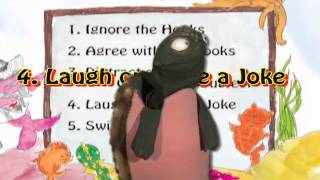
Grandma Rose's Neighborhood Youtube Videos: As a review of the book, or even in place of the book, show these videos to the class. Part one has the intro about how teasing is "throwing a hook". Part two is the story about how the fish learned to swim around the hooks instead of biting. Part three shows some role plays about handling teasing.
Thumbnail
Grandma Rose's Neighborhood Part 1
Thumbnail
Grandma Rose's Neighborhood Part 2

Thumbnail
Grandma Rose's Neighborhood Part 3

Which Strategy is it?

After discussing the strategies of how to avoid biting the hook, we played a little class game. I wrote each of the five strategies on the board. After another student reads the scenario, the class would show me with their hands which number they think the scenario is an example of. Below are the scenarios that I used.

Ignore
The whole class is about to play kickball. Sam says to the Dustin, “We’re gonna beat you guys!”. Dustin looks at Sam and shrugs, thinking to himself, “I really don’t care if they win”

Amy and Sara are playing checkers when Matt approaches them and says to Sara “Your mom is fat”. Amy and Sara continue to play checkers as if nothing had happened.

Agree
Patrick is telling a joke to his friends. “Knock knock!” (who’s there?) “Interrupting Cow!” (interrupting Co-) “MOO!!!”. Chris looks at Patrick without laughing and says- that was a dumb joke. Patrick says “yeah, it sure was!”

Distract
While playing dodgeball, George says “Ha ha you missed me!”. John responds by saying “what I really miss is my X-box. Man I would love to be at home playing that now!”

Laugh/joke
Josh just got finished telling a story to his friends about embarrassing himself this weekend with his family. When he was finished,  Jason said, “wow. Really? How dumb can you honestly be to think that would work!” Josh responds by saying “well, you’d be surprised just how dumb I can be sometimes”

Stay away (avoid)
Kelly started calling Sharon names on the playground. Sharon decided that she’s had enough of the name calling, so she decided to turn around and walk in the other direction from Kelly. 

Role Plays

Students were divided into groups of 4 and were assigned one of the 5 strategies. They came up with a short role play of a situation where a kid used that strategy. While presenting to the class, the other groups had to figure out which topic each of the groups had chosen. 

Game Time!

This is an activity that I saw on lifelessonsforlittleones.com. There is a ship at the top of the board that has a teasing remark, "You're a little shrimp!". There are a lot of fish cards in a pile that have responses to that statement. If the statement is one that "bites" the hook, it is place on top of the baited hook/strings. If it is a statement that helps the fish avoid the hook, they are place on the side with "Free Fish".

Take Away!


At the end of the unit, each of the students received one of these cards to remind them of what they can do to avoid "biting the hook".

Other Activities: 

  • http://www.freekidscrafts.com/handprint_fishing_pole-e1236.html Give each kid a hand cutout, fishing pole, string, and two paper fish. Have kids write a teasing comment on the pole or hand cutout. On one of the fish, write a comment that would be considered "biting" the hook. Glue this fish to the string. On the other fish, write a comment that would represent the "free" fish. 


Sunday, January 20, 2013

Confessions of a Former Bully Lessons


I just got the book, "Confessions of a Former Bully" by Trudy Ludwig, and I have already used it several times!

Here's the book description:
"After Katie gets caught teasing a schoolmate, she's told to meet with Mrs. Petrowski, the school counselor, so she can make right her wrong and learn to be a better friend. Bothered at first, it doesn't take long before Katie realizes that bullying has hurt not only the people around her, but her, too. Told from the unusual point of view of the bullier rather than the bullied, Confessions of a Former Bully provides kids with real life tools they can use to identify and stop relational aggression."

So far, the 3rd and 4th grade girls that I have used this with really seemed to grasp the concepts. This opened the door to talk about the motives behind one girl's bullying behaviors, helped another girl understand ways that she could help when she is a bystander, helped a girl begin to see what the good and bad qualities of a friend are, and gave some useful strategies for another girl who is often the target of teasing. While this book could easily be read from cover to cover, I have been using it more as a reference book depending on the specific situation. I could see this book being the topic of a girls small group, discussing a few pages at a time.

Once concept in the book talks about using "empower" tools as a way of dealing with bullying/teasing. I created these cards as a takeaway for kids, using the same wording from the book and clipart of the tools that correspond with the book.


Bullying Wordles


After four weeks of lessons about bullying, we headed to the computer lab to create some "Wordles" to sum everything up. 

We began by briefly going over some of the important terms that we have learned and other things that we have talked about during lessons. For example, we talked about what bullying is: MOO- Mean, On purpose, and Ongoing. We talked about how to handle bullying: HA HA SO- Help, Assert yourself, Humor, Avoid, Self-talk, Own it. We talked about the role of the bystander using the book "say something".  Students were encouraged to come up with 20 unique words from the things that we had talked about over the last several weeks. 

Below is the bulletin board they were displayed on! 

Make your own Wordle here: www.wordle.com