Search This Blog

Showing posts with label printable. Show all posts

Tuesday, July 1, 2014

Helping Kids Discover Their Passions

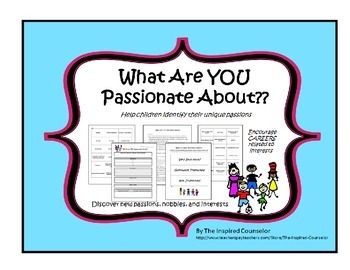
I can't tell you how many times I've asked a child/teen what they are interested in or what they want to do with their life, and they give the shoulder shrug and say "nothing much". This response tells me that they either haven't found their niche or they are generally apathetic and unconcerned with their future. To help overcome this "slump", I created a "Passion Sort" which contains 100 hobbies, interests, and passions that kids might have.

SORT:
I get the students to sort them into three categories: Very Interested, Somewhat Interested, and Not Interested. Next, I get them to look at only the "Very Interested" Category, and narrow it down to the top ten things. Then the top 5. Then the top 3. Then the number one. I use the worksheet on the right for them to record their answers and thoughts. I find it fascinating to see what makes it into the top ten! Sometimes I could have guessed a few of them, but others, they tell me about what matters to them that I would have never known!


ASSESS:
Then, I ask a variety of questions to assess the activity: Describe how you felt when I asked you to get rid of some of your passions? How did you decide which ones to get rid of? What do your top interests have in common? What makes this one the top passion for you? What are you doing RIGHT NOW related to this passion? If you could do ANYTHING related to this top passion, what would you like to do? As a summary, I explain that people all have different things that they are passionate about. We tend to be the happiest when we do things that we are passionate about. The thing that we are most passionate about is the thing that motivates us the most in everything that we do. How has this passion motivated you to do something? We also discuss what potential careers could tie in with their passion. 

WHY?
I use this activity for a variety of purposes. One, it helps the kids learn more about themselves and what really matters to them. Many kids never stop to think about what they personally like, but only what their family gets them involved with. Imagine a kid who could be a musical prodigy that has never so much as touched an instrument! 

Two, it help the kids think logically about future careers and what they would be happiest doing. The best career is one that they truly enjoy doing. 

Three, it can point out if they have a passion that is never expressed. This activity also helps to guide kids towards finding where they belong and where they could fit in, even if they've never tried it before. This is one reason why the group labels say "interested" instead of "enjoyed".

What are YOU Passionate About?

Thursday, August 22, 2013

Never Ending Cards

Every so often, I see things or hear of things that get my wheels turning in my head. I read about a "Never Ending Card" on Dawn's Stamping Thoughts blog and just had to try to make one! It took me about a hundred attempts to get the folding and cutting right, but it was definitely worth the effort because now I'm in love with these cards!  There is a great tutorial on her website- I'm not even going to try to explain how it's done!

Meet the Counselor Cards

After mastering the art of folding never ending cards, I started thinking about how a school counselor could use something like this. One thought was doing a "meet the counselor" card. I wanted to include some information about what the counselor is there for, and important information kids need to know. I'll need to go back and work on the wording and put a bit more effort into the graphics, but it's a start.


Free Template!!
I created a template on Microsoft Publisher and put in some pictures and text about school counselors. I'm not going to lie- it took some time to get everything right in the template! Feel free to use this template to create your own never ending cards! Just follow the folding directions from the blog I mentioned earlier.


Other Possibilities
  • Calm-Down skills
  • Problem solving
  • Affirmations
  • Information for teachers
  • Mini books/ social stories
What else would you use the Never Ending Cards for??

Saturday, April 27, 2013

End of the Year Closure Lessons

This week was very bitter sweet for me, though more sweet than bitter! I have now finished my school counseling internship and will be graduating in just two weeks! This week consisted of tying up some loose ends with individual students and saying my good-byes to groups and classes. Below are some of the closing/termination activities that I did with my students, and some that I didn't do but wanted to share anyways. I hope you enjoy!

Individual

  • Paper Finger Puppets- Found on the blog Seven Thirty Three, I taught some of my younger students how to make these very simple puppets. A lot of my individual work with the younger students has involved puppets. As a final individual session, we both made a paper finger puppet and used it to say goodbye. The students absolutely LOVED it! And it gave them something to take with them to remind them of our time together. 
  • Writing notes- Before I left for the year, I wrote several of the students personalized notes emphasizing their growth over the school year, and included some empowering words to encourage them to continue to work towards their goals. 
  • Bridge- Have the student draw a bridge in the middle of a sheet of paper. One one side is where the student used to be, and on the other is where he is now. Under the bridge- what obstacles did you have to overcome? This can also be done with two bridges, with the last one being where you would like to be, and what obstacles you might have to overcome to get there. This activity can be used at the beginning of counseling as well to give direction to the sessions. 
  • Letters to the past/future you-Have the student write a letter to him/herself in the past or the future. If you could time travel to the past/future what would you tell yourself?
  • Lines of Feelings. Ask the student to draw a line that represents their feelings over the past (year, month, week, etc). All of the lines will vary, but usually the jagged or rough lines in red or orange are used to signify anger or discontent, and the smooth, flowing lines in blues and greens are usually used to show calmness and contentment. After the lines are drawn, the student can expand on them by writing about what the lines represent, how it feels to draw them, or to whom or what they are directed.  

Groups
  • Flower Petals- The flower represents the group growing over time. A flower starts as a bud, and you can not see the petals yet. But over time, with water and sun, the petals begin to unfold, creating a beautiful flower. Place a circle in the center of the group, and tell them that this represents the bud, before group began. There were many things that you know now that you didnt know before. Give each student a paper flower petal, and say one thing that they have learned from the group. Have the student symbolically tape the flower petal to the circle. Continue until everyone has done this. 
  • String tying- From Diane Senn's book Creative Approaches to Counseling Individual Children. I used this at the end of my fourth grade girls friendship group to help remind the girls that it is okay to ask for help when they have problems, and that your friends are often a great source of help. Start by giving each girl a string that is at least one foot long. Tell them to tie a knot in a string. This is pretty simple for them to do. Some problems are easy to handle yourself. Then, instruct them to hold both ends of the string without letting go and tie a knot. Tell them that it is okay to ask for help. After letting them try for a few minutes, ask them if they would like some help. Ask one student to cross her arms, then hand her the ends of the string in each of her hands. Have her unfold her arms without letting go of the string, and a knot will be tied in the string. Allow the girls to help one another with this. Tell the girls that sometimes we have problems that we are not sure how to fix, and it is okay to ask someone else for help, and sometimes it takes a creative solution to solve their problems. Friends help us get through some of the tough problems we have, but when friends cant help, your school counselor is still there for you. 
  • Choose a Picture- Print out a variety of different pictures, such as animals, scenery, symbolic pictures, people, etc that represent a variety of emotions and different points of view- both positive and negative. Lay the pictures out on the floor and ask students to choose the picture that shows how they feel, what they will take away from the experience/group. Process what the picture chosen means to each individual. This site does a great job of explaining this method of closure. 
  • Group Puzzle/Mandala- Give each student a piece of the puzzle or a piece of the mandala and let each student decorate it. At the end, let each student symbolically place their puzzle piece or mandala piece back into the puzzle, saying one thing that they have enjoyed or have learned during the group. Allow students to keep the finished product in their class to remember the good times together.
Classroom
  • The Giving Tree- I wanted to incorporate a finger-print tree into the lesson somehow, and my supervisor suggested I use the The Giving Tree with it. That got my wheels turning! I used the book with first grade and up, adjusting the lesson slightly to accommodate for developmental differences. Before reading the book, I asked the students to be thinking about who they can relate to more- the tree or the boy. I then read the book to the class without stopping for inserting my own interpretation of what was going on. After I read the book, I asked them again who thinks they are more like the tree or more like the boy. In most classes it was about half and half. I let a few students explain why they thought they were more like one or the other. Then I told them that sometimes I feel like both. I feel like the tree because as a counselor, I will gladly give my students anything and everything that I have to help them when they need it. But at times, I have felt like the boy, and the students were the tree. In the same way that the boy got what he needed every time he asked for it, I got what I needed to become a school counselor from the students. I told them that they have taught me so much more than I have taught them this year, and thanked them for helping me learn how to be a school counselor. At the end of the lesson, I let each student come up and put a finger print on the tree, using a washable marker. (In later classes I decided to just have them write their names on the branches in different colors). I then wrote a note to the class and gave it back to them to keep in their classroom to remember our time together, and to remember that it's okay to be like the tree AND like the boy. 
  • Toss 'n Talk ball- For some classes, the students had many questions for me about why I am leaving and what I would be doing after I'm gone. After answering a few questions, I got out a inflatable ball and asked students what their favorite memory with me was this year, in 2-3 words. I used the ball as a talking tool- only the person who has the ball can talk. I gave each student a turn to catch the ball and say a favorite memory. 
  • Class Rap- I did not do this one, but it was my back up. The students are finishing up a poetry unit, so to incorporate this, I was going to have the students write a haiku about what they will take away from our time together this year. After they wrote the poems, we would all sit in a circle. Depending on the age and ability, I would divide the class into 2-4 groups, and give each group a rhythm to clap to a given beat, and maybe even having a student being our "beatboxer" to be our percussion. Then one at a time, students would read their poems in rhythm with the class's beat. 
  • Empowering Words- Adapted from Kellybear.com-  Close the year out with some positive and encouraging words! Have students think about some thoughts that help them feel better when they are feeling sad.This is called positive self-talk. Brainstorm thoughts that can help on the board. After the class is brainstormed out, have them choose one statement that is meaningful to them and draw a picture about it. Allow time to share. Remind kids that even though they may feel sad about things (such as a teacher/counselor intern leaving them, or something else sad), they have the power to control their thoughts and can think about these things to make them feel better. Leave with encouraging words challenging them to be their best! (These positive self-statements could make a nice end-of-year bulletin board!)
  • Paper Quilt- have each student draw their favorite memory from the year on a square sheet of paper. Tape the pictures together, or put into a gallon-bag quilt format to display, like the one here


Sunday, January 20, 2013

Confessions of a Former Bully Lessons


I just got the book, "Confessions of a Former Bully" by Trudy Ludwig, and I have already used it several times!

Here's the book description:
"After Katie gets caught teasing a schoolmate, she's told to meet with Mrs. Petrowski, the school counselor, so she can make right her wrong and learn to be a better friend. Bothered at first, it doesn't take long before Katie realizes that bullying has hurt not only the people around her, but her, too. Told from the unusual point of view of the bullier rather than the bullied, Confessions of a Former Bully provides kids with real life tools they can use to identify and stop relational aggression."

So far, the 3rd and 4th grade girls that I have used this with really seemed to grasp the concepts. This opened the door to talk about the motives behind one girl's bullying behaviors, helped another girl understand ways that she could help when she is a bystander, helped a girl begin to see what the good and bad qualities of a friend are, and gave some useful strategies for another girl who is often the target of teasing. While this book could easily be read from cover to cover, I have been using it more as a reference book depending on the specific situation. I could see this book being the topic of a girls small group, discussing a few pages at a time.

Once concept in the book talks about using "empower" tools as a way of dealing with bullying/teasing. I created these cards as a takeaway for kids, using the same wording from the book and clipart of the tools that correspond with the book.