Search This Blog

Showing posts with label middle school. Show all posts

Tuesday, June 24, 2014

Student Mentor Program

I have recently designed a new program that I am excited about implementing! It's a Student Mentor Program, in which carefully selected older and more responsible students are trained to mentor younger students who may be struggling with social, academic, or behavioral concerns. Similar to "Peer Mediators" or "Peer Helpers", the Student Mentors will help the counselor reach even more students and create a lasting impact on  the school environment.

Who??
The program would work great with elementary or middle school, but could also easily be adapted to high school. Alternatively, if you have different level schools nearby, arrange it to have high school students mentor middle school students.

Mentors would be responsible role model students who apply (and interview!) for the position of mentor. They would meet regularly with the School Counselor for quick individual check-ins and for after school group trainings. They will be taught how to help younger students manage conflicts, handle strong emotions, and provide general encouragement and friendship.

Mentees would be students who are "frequent flyers" in the counselor's and/or pricipal's office. The may need additional support outside of what the caring adults in the school can provide. An example of the ideal mentee is one who is constantly asking to speak to the school counselor about little problems, or one who is trying to fit in with their peers. To these students, their mentor will be an older friend who they get to hang out with and talk to once a week.

What?
Student mentors will be trained in being a mentor. They will receive explicit instruction on how to encourage and lead a younger student, and how to help with many problems that they face. In a way, mentors will be "Counselor Helpers" or "Peer Helpers". When the counselor's schedule is packed (like it always is), student mentors can help younger students with some of the small problems that they face, while becoming expert problem solvers themselves!

When and where?
I see this being a year-long program. Mentors should meet with their mentee once per week for 20-30 minutes, during non-instructional time. Training would take place at least once per month after school, when all mentors are able to attend. Mentors would also check in periodically with the counselor (5-10 minutes, before or after school) so that the counselor can monitor their progress and answer any questions they have.

Why?
Let's face it- School Counselors are BUSY!! This mentor program is a way that you as a school counselor can impact even more students. You teach mentors how to help, and start the snowball effect of students helping students. Soon enough, your entire school will feel the impact! There have been many studies done about the effects of mentoring on student achievement, but unfortunately there is a lack of willing {adult} mentors in our community. But who says mentors can't be children too?

 
(Get this poster FREE here)

Suggested steps to implement program:
  1. .    Inform teachers of the mentoring program at a staff meeting. Explain the potential benefits for mentors and for mentees, and how it will impact the school as a whole.
  2. .    Class introduction lesson. Meet with classes of older students to discuss the mentoring program. Emphasize the amount of responsibility and dedication that being a mentor will require. Leave information and copies of the Mentor Application with teacher. Teacher will give applications to students who are interested, as well as the parent information sheet. (Another possible route is to open the applications up to your student council or other student leadership groups, or simply ask teacher for recommendations and ask those specific students if they are interested)
  3. .    Once students turn in complete applications, meet with those students individually or in a small group (lunch bunch). Discuss overall objective of the program, specific requirements, and answer any questions they may have.
  4. .    Meet with possible mentees, explaining what their mentor will be doing with them. Give mentees pre-assessment. Mentees should be students in younger grades who need additional support, but do not typically have big problems or concerns. Check with parents of mentees before initiating mentoring.
  5. .    Schedule after-school training session to go over additional details of the program. (See list below of suggested training items) Give out pre-assessments to all mentors.
  6. .    Pair up mentors with mentees.
  7. .    Meet regularly with mentors to discuss progress (before school check-ins or during lunch) 

Suggested Trainings: At each training, include a handout for students to keep in their notebook for reference. I would suggest doing an interactive notes style handout to further engage the students.
  •       What specifically is expected of mentors (What is a mentor? How can I help?)
  •       How to conduct a peer mediation session
  •       Promoting empathy and kindness in others
  •       Strategies for handling anger, sadness, stress
  •       Strategies for solving "small problems"
  •       What is effective communication?
  •       What to do if… (reporting "big" problems, what if you're not sure what to say?, etc)

Other fun mentor program ideas
  •       Have a "Mentor Night" or "Mentor Fair" at the end of the school year where student mentors present information on their impact with younger students. Have students create trifold poster with what they have learned from the program, how they helped their mentees, and the overall impact of the mentoring program on the school. For maximum participation, hold the event during a PTA night or in conjunction with other big school events (talent show, science fair, etc)
  •       Create matching T-shirts or bags for mentees (Vistaprint!)
  •       Give out certificates for participation in the Mentor program at Honor Roll ceremony.


If you are interested in starting a Student Mentoring Program at your school, check out my Student Mentor Program Pack on Teachers Pay Teachers! It includes information sheets, application, Mentor Notebook pages, assessments, and four training lessons. 
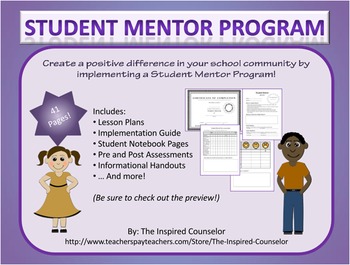
Student Mentor Program

Finally, if you have started a Student Mentoring Program at your school, I'd love to hear how it is going and any suggestions that you have for the program!

Thursday, August 22, 2013

Origami Group

After learning about how to make Never Ending Cards, I started thinking about what kids could learn from folding paper. Turns out there is quite a bit that can be learned by making a few folds in a sheet of paper! Below are just a few of the benefits that students would gain from learning Origami.

Academic
  • Shapes (Identifying basic shapes, new shapes made from folding)
  • Symmetry (Much of Origami is symmetric)
  • Angles (You had a right angle, but folded it in half. Now how many degrees is the angle?)
  • Fractions (You just folded this paper in half three times. How many sections do you have?)
  • Following Directions (Some instructions for making Origami can be very specific and detailed.) 
  • Reading with a purpose (For an added challenge, only provide step-by-step instructions and no pictures)
Personal/Social
  • Teaches patience and concentration through attention to detail
  • Teaches perseverence- if they get frustrated with a project, keep trying
  • Making mistakes is a part of the learning process
  • Problem Solving skills- How can you fix your mistakes/ "happy accidents"
  • Gives students a positive hobby/ skill that can be shared with others
  • Gives an outlet for ADHD energy and fiddling
  • Kids can share their hobby through making gifts for others (encourage Random Acts of Kindness!!)
Career
  • Learning how to create a 3D object out of a flat sheet of paper = foundation of Science, Technology, Engineering and Math (STEM)
  • Students learn to pick up on and apply patterns from folding to other subjects and careers 
Origami Group
I have not yet run an origami group, but it's definitely on my list of groups I'd like to run! I would gear it to 3rd grade and up. Each week, we would focus on a different topic such as having patience, making mistakes, following directions, etc. I would also have them create at least one project each week. I might even throw a challenge at them to deconstruct and recreate a completed origami project. They could make origami to sell as a school fundraiser, or lead a school wide service project making origami for Sandy Hook.

Classroom Guidance Lesson

Using the book, Spread Your Wings and Fly by Mary Saunders, have students fold along with the story in the book as you read. Here is the book description from Amazon.com: An Origami Fold and Tell...the ancient Japanese art of origami provides a framework for enhancing self-esteem and achieving spiritual attunement that will stay with readers as they work through the book, as well as the various phases of their lives.

Sadako and the Thousand Paper Cranes: Here is the book description from amazon: Born in Hiroshima in 1943, Sadako was the star of her school's running team, until the dizzy spells started and she was forced to face the hardest race of her life-the race against time.

Empowering Kids 
I would like to leave you with one final note- a direct quote from an article on Enso Journey: The Power of Origami: How it can make you a better person: (I definitely encourage you to read this article!)

"I created something out of nothing. From a simple piece of paper, a new creature was born. For each new piece I made, I felt I had the power to change the world. I could do anything, even if I had nothing to begin with, I could do it."

Sunday, April 21, 2013

Career Exploration Lessons- Webquest

This month we have been focusing on careers. I wanted to do some type of self-exploration activity with the students where they learn a bit about themselves and find careers that match their interests/personality. Initially, I was hoping to find a webquest of sorts for the students to explore, but was not able to find anything age appropriate that I liked. There were a few great websites, but none that had everything I was wanting to cover. Instead, I decided to create my own mini-webquest. I have included powerpoint presentations that I have created, as well as a worksheet to go along with the websites. All of the links are listed below. I hope that other school counselors will be able to use some of these resources to help your students explore careers!

Lesson 1: Introduction to Careers- why people choose career (30-45 minutes)
PowerPoint Presentation

On day one talking about careers, we discussed the definition of a "cluster" (relating it back to the career clusters), discussed why adults work, and how they choose their jobs. The students then created a story by entering a few words about what they like or enjoy doing, using this site. Below is a sample story made by this site! There is also a printable story where students just write in the words.
 Lesson 2: Career Exploration (45-60 min.)

Each student received a worksheet to guide them through this "webquest". As a review of the previous lesson about choosing careers based on interests and personality, the students started by learning their "Holland Code" by using this quick assessment from GetReadyforCollege.org. In this assessment, students simply check the box next to the things that interest them. Once they submit, they are given a score for each of the 6 Holland Codes. After students have learned what their Holland Code is, we discussed as a class what each one meant, and what kinds of careers people with those personalities would typically like. 

Next, students searched using Paws In Jobland for jobs related to their interests. They were to choose three jobs that are most interesting to them, and write down why they would be a good fit for those jobs, based on interests/personalities. 

Once a teacher verified that they had completed the search site, they could go to VA Career View to explore more careers through games and activities.  


Career Links:
Lesson 1:
Lesson 2: