Search This Blog

Showing posts with label kindness. Show all posts

Tuesday, June 24, 2014

Student Mentor Program

I have recently designed a new program that I am excited about implementing! It's a Student Mentor Program, in which carefully selected older and more responsible students are trained to mentor younger students who may be struggling with social, academic, or behavioral concerns. Similar to "Peer Mediators" or "Peer Helpers", the Student Mentors will help the counselor reach even more students and create a lasting impact on  the school environment.

Who??
The program would work great with elementary or middle school, but could also easily be adapted to high school. Alternatively, if you have different level schools nearby, arrange it to have high school students mentor middle school students.

Mentors would be responsible role model students who apply (and interview!) for the position of mentor. They would meet regularly with the School Counselor for quick individual check-ins and for after school group trainings. They will be taught how to help younger students manage conflicts, handle strong emotions, and provide general encouragement and friendship.

Mentees would be students who are "frequent flyers" in the counselor's and/or pricipal's office. The may need additional support outside of what the caring adults in the school can provide. An example of the ideal mentee is one who is constantly asking to speak to the school counselor about little problems, or one who is trying to fit in with their peers. To these students, their mentor will be an older friend who they get to hang out with and talk to once a week.

What?
Student mentors will be trained in being a mentor. They will receive explicit instruction on how to encourage and lead a younger student, and how to help with many problems that they face. In a way, mentors will be "Counselor Helpers" or "Peer Helpers". When the counselor's schedule is packed (like it always is), student mentors can help younger students with some of the small problems that they face, while becoming expert problem solvers themselves!

When and where?
I see this being a year-long program. Mentors should meet with their mentee once per week for 20-30 minutes, during non-instructional time. Training would take place at least once per month after school, when all mentors are able to attend. Mentors would also check in periodically with the counselor (5-10 minutes, before or after school) so that the counselor can monitor their progress and answer any questions they have.

Why?
Let's face it- School Counselors are BUSY!! This mentor program is a way that you as a school counselor can impact even more students. You teach mentors how to help, and start the snowball effect of students helping students. Soon enough, your entire school will feel the impact! There have been many studies done about the effects of mentoring on student achievement, but unfortunately there is a lack of willing {adult} mentors in our community. But who says mentors can't be children too?

 
(Get this poster FREE here)

Suggested steps to implement program:
  1. .    Inform teachers of the mentoring program at a staff meeting. Explain the potential benefits for mentors and for mentees, and how it will impact the school as a whole.
  2. .    Class introduction lesson. Meet with classes of older students to discuss the mentoring program. Emphasize the amount of responsibility and dedication that being a mentor will require. Leave information and copies of the Mentor Application with teacher. Teacher will give applications to students who are interested, as well as the parent information sheet. (Another possible route is to open the applications up to your student council or other student leadership groups, or simply ask teacher for recommendations and ask those specific students if they are interested)
  3. .    Once students turn in complete applications, meet with those students individually or in a small group (lunch bunch). Discuss overall objective of the program, specific requirements, and answer any questions they may have.
  4. .    Meet with possible mentees, explaining what their mentor will be doing with them. Give mentees pre-assessment. Mentees should be students in younger grades who need additional support, but do not typically have big problems or concerns. Check with parents of mentees before initiating mentoring.
  5. .    Schedule after-school training session to go over additional details of the program. (See list below of suggested training items) Give out pre-assessments to all mentors.
  6. .    Pair up mentors with mentees.
  7. .    Meet regularly with mentors to discuss progress (before school check-ins or during lunch) 

Suggested Trainings: At each training, include a handout for students to keep in their notebook for reference. I would suggest doing an interactive notes style handout to further engage the students.
  •       What specifically is expected of mentors (What is a mentor? How can I help?)
  •       How to conduct a peer mediation session
  •       Promoting empathy and kindness in others
  •       Strategies for handling anger, sadness, stress
  •       Strategies for solving "small problems"
  •       What is effective communication?
  •       What to do if… (reporting "big" problems, what if you're not sure what to say?, etc)

Other fun mentor program ideas
  •       Have a "Mentor Night" or "Mentor Fair" at the end of the school year where student mentors present information on their impact with younger students. Have students create trifold poster with what they have learned from the program, how they helped their mentees, and the overall impact of the mentoring program on the school. For maximum participation, hold the event during a PTA night or in conjunction with other big school events (talent show, science fair, etc)
  •       Create matching T-shirts or bags for mentees (Vistaprint!)
  •       Give out certificates for participation in the Mentor program at Honor Roll ceremony.


If you are interested in starting a Student Mentoring Program at your school, check out my Student Mentor Program Pack on Teachers Pay Teachers! It includes information sheets, application, Mentor Notebook pages, assessments, and four training lessons. 
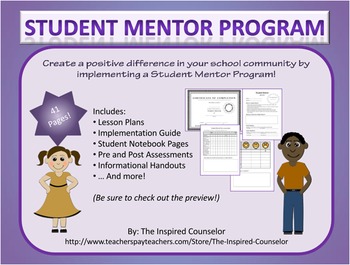
Student Mentor Program

Finally, if you have started a Student Mentoring Program at your school, I'd love to hear how it is going and any suggestions that you have for the program!

Thursday, August 22, 2013

Origami Group

After learning about how to make Never Ending Cards, I started thinking about what kids could learn from folding paper. Turns out there is quite a bit that can be learned by making a few folds in a sheet of paper! Below are just a few of the benefits that students would gain from learning Origami.

Academic
  • Shapes (Identifying basic shapes, new shapes made from folding)
  • Symmetry (Much of Origami is symmetric)
  • Angles (You had a right angle, but folded it in half. Now how many degrees is the angle?)
  • Fractions (You just folded this paper in half three times. How many sections do you have?)
  • Following Directions (Some instructions for making Origami can be very specific and detailed.) 
  • Reading with a purpose (For an added challenge, only provide step-by-step instructions and no pictures)
Personal/Social
  • Teaches patience and concentration through attention to detail
  • Teaches perseverence- if they get frustrated with a project, keep trying
  • Making mistakes is a part of the learning process
  • Problem Solving skills- How can you fix your mistakes/ "happy accidents"
  • Gives students a positive hobby/ skill that can be shared with others
  • Gives an outlet for ADHD energy and fiddling
  • Kids can share their hobby through making gifts for others (encourage Random Acts of Kindness!!)
Career
  • Learning how to create a 3D object out of a flat sheet of paper = foundation of Science, Technology, Engineering and Math (STEM)
  • Students learn to pick up on and apply patterns from folding to other subjects and careers 
Origami Group
I have not yet run an origami group, but it's definitely on my list of groups I'd like to run! I would gear it to 3rd grade and up. Each week, we would focus on a different topic such as having patience, making mistakes, following directions, etc. I would also have them create at least one project each week. I might even throw a challenge at them to deconstruct and recreate a completed origami project. They could make origami to sell as a school fundraiser, or lead a school wide service project making origami for Sandy Hook.

Classroom Guidance Lesson

Using the book, Spread Your Wings and Fly by Mary Saunders, have students fold along with the story in the book as you read. Here is the book description from Amazon.com: An Origami Fold and Tell...the ancient Japanese art of origami provides a framework for enhancing self-esteem and achieving spiritual attunement that will stay with readers as they work through the book, as well as the various phases of their lives.

Sadako and the Thousand Paper Cranes: Here is the book description from amazon: Born in Hiroshima in 1943, Sadako was the star of her school's running team, until the dizzy spells started and she was forced to face the hardest race of her life-the race against time.

Empowering Kids 
I would like to leave you with one final note- a direct quote from an article on Enso Journey: The Power of Origami: How it can make you a better person: (I definitely encourage you to read this article!)

"I created something out of nothing. From a simple piece of paper, a new creature was born. For each new piece I made, I felt I had the power to change the world. I could do anything, even if I had nothing to begin with, I could do it."

Friday, March 29, 2013

Name Calling and Compliments Lesson

I did another lesson with first and second graders about the power of their words. We had discussed during the last class that words have the power to build someone up or tear someone down, depending on how you use them. This lesson helps to tie everything together, and provides a little extra help with how to compliment others and also how to receive a compliment.

Materials Needed:
Ball of yarn
Two sheets of paper (or space to write a T-chart)
Marker
(Scissors)
Class sitting in a circle

Introduction
To begin this lesson, I had each of the students share how they got their name (named after someone else, a place, a thing, for the meaning of their name, etc). I explained that your name is very important because that is the first thing that anyone learns about you when they first meet you. "Hello- my name is ___. What is your name?" If names are so important, how might it make you feel if someone started calling you by the wrong name? What about if someone calls another person ugly? This is what we call "name calling", or a put-down.

Brainstorm!
We then created two charts- one with "name calling/ put-down" and the other with "compliments/ put-ups". We brainstormed words and phrases for both categories, and talked about how it would make someone feel to be called one of the things from the list.  I reminded students that words have the power to build someone up or to tear them down. Everyone agreed that they would like to be called something from the compliment list.

Compliment Web
Using the ball of yarn, we created a web of compliments in the classroom. I started it off by wrapping my finger around the end of the yarn one time, showing the class what is expected. I then complimented one student in the class and rolled the ball to that student. The student responds by saying "thank you" , wrapping their finger around the yarn, then saying a compliment to another student in the class, so on and so forth until every student has received the yarn and a compliment. This helps students not only learn how to give compliments, but what to do when they receive compliments as well.

Tying It All Together
As a class, we talked about how good it made everyone feel to receive a compliment. I pointed out the fact that people who were across the circle from one another were could feel the string move every time another person pulled on the string. In the same way, when we hear one person giving another person a compliment, that also makes us feel good. Compliments are contagious! Before I left the class, I cut off a piece of the yarn for the teacher to keep in the classroom as a reminder to give people compliments instead of calling them names.

Saturday, March 23, 2013

The Power of Words Name Calling and Compliments Lesson


During first and second grade classroom guidance this week, we talked about  how powerful words are. Words can either tear a person down or build them up. They can make a person feel really sad or angry, or can make them feel happy or proud.

Introduction:
I introduced this topic by writing the following phrase on the board: "Sticks and stones may break my bones, but words can never hurt me." We discussed whether or not this was a true statement. If someone hit me in the arm with a stick, would that leave a mark? If someone threw a rock and hit me in the leg, would that leave a bruise? What if someone said something really mean to me? What would that hurt? Sticks and stones may physically hurt your body- leave bruises or scratches, but words hurt a different part of your body- your heart/feelings.

Video:
We watched a short video about someone who got called names, and then talked about how it makes people feel to be called names, and we discussed what they did in the video to make things better between them. We then reviewed how powerful words can be when used to either build someone up or tear them down.  

Class Activity:
For the activity, I wanted the students to practice using their words to build others up- by using compliments. I taped a sheet of paper to every kid’s back with their name on it, and instructed the class to write something positive about each person in the class. Afterwards, I collected each of their sheets of paper- (before they looked at it so that I could read over them to make sure everyone wrote kind things).

Closure:
As the students left, I gave the papers back for them to take home and to remember how powerful their words can be.  How did the compliments make you feel? Was this easy or hard to come up with compliments for everyone? Knowing what we learned about the power of your words, what will you try to do differently this week? Many of the students were very excited to have all of the nice things said about them during today's lesson! 


Sunday, January 20, 2013

Random Acts of Kindness Week

Random Acts of Kindness week is Feb. 11-17. My Secret Service Group will be helping me during the RAK week, as they are the experts in the field! We have decided to start off each day with morning announcements. 

Our main Random Acts of Kindness activity will be a school-wide RAK bulletin board. My Secret Service agents suggested that we decorate the bulletin board with paper people chains, so that everyone is "holding hands" and showing kindness! Their homework this weekend was to make the chains so I can staple them on the board! 

All students at the school are invited to participate in RAK week. When students complete a RAK, they will write (or draw) on a heart cut-out about what they did. The hearts will then all be posted on a bulletin board. I am excited to see the bulletin board fill up with hearts this week! I will also be adding pictures of students helping other students.


Random Acts of Kindness week morning announcements:

Monday:
Good morning! This is ____ from Ms.____’s class. This week is National Random Acts of Kindness week. We perform Random Acts of Kindness when we go beyond what is expected of us and reach out to help another person. There are three simple steps to performing a Random Act of Kindness.

  • The first step is to find out what another person needs. For example, Sally has her hands full and she needs to open the door to get to her class.
  • The second step is to think about how you would feel if you had that need. You might feel frustrated if your hands were full and you could not easily open the door by yourself.  
  • The final step to performing a Random Act of Kindness is to offer your help. Hold the door open and let Sally enter.
There are hundreds of ways to show someone that you care. This week, look for opportunities to show that you care by performing Random Acts of Kindness.
Tuesday:
Good morning! This is ____ from Ms.____’s class. Today is the second day of National Random Acts of Kindness week. Today’s message is about Kindness and empathy.  Kindness and empathy are very closely related: kindness is simply empathy in action. When we understand how someone feels and then do something about it, we are showing kindness. Even if you sometimes do not think that anyone notices when you are being kind, remember the words of the Ancient Storyteller, Aesop. “No act of Kindness, however small, will go unnoticed”.
Wednesday:
Good morning! This is ____ from Ms.____’s class. Today is the third day of National Random Acts of Kindness week. Today’s message is about showing appreciation to those who help you. Appreciation is when you are thankful for what someone else has done for you. Do you have a friend that you can always depend on? Has one of your teachers taken the extra time to help you learn something new? Try to find the time today to say thank you to the people who mean the most to you. Remember: a simple “thank you” can go a long way!
Thursday:
Good morning! This is ____ from Ms.____’s class. Today is the fourth day of National Random Acts of Kindness week. Today’s message is about making and keeping friends. One study found that children who performed Random Acts of Kindness felt more accepted by their classmates, and had more friends than the children who did not perform Random Acts of Kindness. When you are kind to others, more people want to be around you.  Being kind to others is one of the best ways to make and keep friends! How will you show kindness to kids in your class today?
 (adapted from: National Public Radio)
Friday:
Good morning! This is ____ from Ms.____’s class. Today is the final day of National Random Acts of Kindness week. Today’s message is about passing kindness on.  When we do kind things for people, they feel so good about what we did that they often do kind acts for others. As kindness is passed on from one person to another, an outward ripple effect is created, like a raindrop that falls into water.  In this way, one Random Act of Kindness can be passed on and on, bringing happiness to many others. Anthropologist Margaret Mead once said, “Never believe that a few caring people can’t change the world. For, indeed, that’s all who ever have.” Thanks to all the students and staff for helping to make this a great week. Now let’s all work together to pass the kindness on throughout our school and into our community.
(adapted from: Randomactsofkindness.org)


Other runner-up ideas for RAK week:


  • Bulletin board in the main hallway for teachers, parents, and students to write a note to someone who has made their day, or to thank someone for what they have done. Pens would be attached to the bulletin board so people could write something when passing through.
  • Valentines Day theme: get the whole school involved by having all students write on a heart diecut any time they see someone performing a RAK. Put the hearts up on the board. My Secret Service group had the idea of creating a border for the bulletin board by making and decorating paper chain people holding hands. 
  • Morning announcements with a positive quote to start the day
  • Graffiti positive quotes on the sidewalks with sidewalk chalk  
  • Mirrorless Monday - promoting self-esteem. Be kind to yourself.
  • Pay it Forward (starting with a few people doing RAK's, watching it spread through the school. Haven't worked out the kinks yet. Please let me know if you have a similar idea!)
  • RAK board- all students have the option of participating in. For the entire week, students will try to complete every activity on their board, and turn in their completed board to their teacher at the end of the week.


Secret Service Group


I'm very fortunate to have a site supervisor for my internship who encourages me to try new things and to make mistakes. I've done a little of both with this group! When I told her about the idea of having a Secret Service group, she was very supportive of the idea. I got the inspiration for the Secret Service group from Dianne Senn’s book, Small Group Counseling, Grades 2-5. After reading about her Secret Service club, my wheels started to turn!

Before the group started, I met with each student. I gave them a manila envelope with “TOPSECRET” printed on it. Inside the envelope, was the official secret service invitation and parent consent to be in the group. I told each student to return the envelope with parent signatures to asecret location outside of my office. I also explained to them that the US Secret Service’s job is to serve and help the country through protecting its’ leaders. This group will serve and help the school by doing random acts of kindness (Intro by Dianne Senn).

Another great introduction to Random Acts of Kindness is a Youtube video by Life Vest Inside- Kindness Boomerang. In this video, one act of kindness causes another person to want to do something kind for another, and so on. This is a great "real life" example of paying it forward, and sparks a conversation about how easy it can be to be kind. Click on the picture to play the video.

Each week, I assign a secret mission to the Secret Service Agents. This could be anything from giving compliments to a classmate, or writing anonymous thank you notes to teachers around the school. I usually print the assignments out on a half-sheet of paper so that it fits into their envelop. Some of the missions may be written in code so that the students have to decipher it first! The students keep track of their service assignments in a journal. After each completed assignment, the students record the responses of the recipient of the deed, or their own responses (feelings, thoughts, other ideas). We use the journal as a springboard for group discussions.

I have also challenged my group of 6 students to do a combined total of 100 Random Acts of Kindness throughout the duration of our group meetings. We brainstormed different things that each person could do to earn extra stars (see list below). My goal in doing this is to encourage them to constantly be on the lookout for kind things to do for other people, rather than simply focusing on one task each week. A quote/motto that we often refer to in group is, "No act of kindness, no matter how small, will go unnoticed" -Aesop. They are not doing the services to get recognition for themselves, but rather for the satisfaction of knowing that they are making a difference in someone's life.

I created a group notebook (below) that is hidden in an “undisclosed location”. This notebook serves as a source of information and a means of communication for group members. If the students have questions during the week, they can refer to the notebook. (This also helps me with the group since I am an intern and am not at school all week to answer their questions). Included in the notebook are some of the most common questions- the date and time of the next meeting, the agenda for the next meeting, our list of ideas for secret service projects, extra copies of handouts, and a chart to keep track of the 100 assignments as they are completed. 

This group has been great for building students' friendship, leadership, and social skills, in addition to promoting students' positive self-esteem. So far, the kids are very enthusiastic about being members of the Secret Service at school. I have already noticed some changes in how the students are treating one another during group time. They were beyond excited to learn that they are the school's ONLY Secret Service, and that the only adults who know about the Secret Service besides me are their classroom teachers and their parents. I am excited to see how the rest of our group meetings turn out!


Extra Stars Ideas:
Pick up trash in your classroom
Be a peer helper to a life skills class 
Read to younger students 
Offer to help someone in your class with an assignment they are struggling with
Say thank you to cafeteria staff 
Smile to someone who may be having a hard day
Say “good morning” to someone you don’t normally speak to
Offer to get extra materials for someone (pencil, paper, textbook, fork, napkins, etc)
Stand up to a bully- don’t just be a bystander
Do an extra chore at home without being asked
Invite someone to play with you at recess who is not playing with anyone
Send a letter to an adult friend (with parent’s help)
Write a thank you note to a parent
Host a collection drive for an important cause
Put up positive posters around school (get adult approval first)
Give compliments to classmates, teachers, or students you do not know
Leave anonymous positive notes in a classmate’s or teacher’s desk
Put out birdseed after it snows
Hold the door open for the next person
Draw a picture for someone
Sit by someone different at lunch
Take time to get to know someone new
Puppet show to teach younger kids about friendship
Offer to help a specials teacher during your lunch time