Search This Blog

Showing posts with label conflict. Show all posts

Tuesday, June 24, 2014

Student Mentor Program

I have recently designed a new program that I am excited about implementing! It's a Student Mentor Program, in which carefully selected older and more responsible students are trained to mentor younger students who may be struggling with social, academic, or behavioral concerns. Similar to "Peer Mediators" or "Peer Helpers", the Student Mentors will help the counselor reach even more students and create a lasting impact on  the school environment.

Who??
The program would work great with elementary or middle school, but could also easily be adapted to high school. Alternatively, if you have different level schools nearby, arrange it to have high school students mentor middle school students.

Mentors would be responsible role model students who apply (and interview!) for the position of mentor. They would meet regularly with the School Counselor for quick individual check-ins and for after school group trainings. They will be taught how to help younger students manage conflicts, handle strong emotions, and provide general encouragement and friendship.

Mentees would be students who are "frequent flyers" in the counselor's and/or pricipal's office. The may need additional support outside of what the caring adults in the school can provide. An example of the ideal mentee is one who is constantly asking to speak to the school counselor about little problems, or one who is trying to fit in with their peers. To these students, their mentor will be an older friend who they get to hang out with and talk to once a week.

What?
Student mentors will be trained in being a mentor. They will receive explicit instruction on how to encourage and lead a younger student, and how to help with many problems that they face. In a way, mentors will be "Counselor Helpers" or "Peer Helpers". When the counselor's schedule is packed (like it always is), student mentors can help younger students with some of the small problems that they face, while becoming expert problem solvers themselves!

When and where?
I see this being a year-long program. Mentors should meet with their mentee once per week for 20-30 minutes, during non-instructional time. Training would take place at least once per month after school, when all mentors are able to attend. Mentors would also check in periodically with the counselor (5-10 minutes, before or after school) so that the counselor can monitor their progress and answer any questions they have.

Why?
Let's face it- School Counselors are BUSY!! This mentor program is a way that you as a school counselor can impact even more students. You teach mentors how to help, and start the snowball effect of students helping students. Soon enough, your entire school will feel the impact! There have been many studies done about the effects of mentoring on student achievement, but unfortunately there is a lack of willing {adult} mentors in our community. But who says mentors can't be children too?

 
(Get this poster FREE here)

Suggested steps to implement program:
  1. .    Inform teachers of the mentoring program at a staff meeting. Explain the potential benefits for mentors and for mentees, and how it will impact the school as a whole.
  2. .    Class introduction lesson. Meet with classes of older students to discuss the mentoring program. Emphasize the amount of responsibility and dedication that being a mentor will require. Leave information and copies of the Mentor Application with teacher. Teacher will give applications to students who are interested, as well as the parent information sheet. (Another possible route is to open the applications up to your student council or other student leadership groups, or simply ask teacher for recommendations and ask those specific students if they are interested)
  3. .    Once students turn in complete applications, meet with those students individually or in a small group (lunch bunch). Discuss overall objective of the program, specific requirements, and answer any questions they may have.
  4. .    Meet with possible mentees, explaining what their mentor will be doing with them. Give mentees pre-assessment. Mentees should be students in younger grades who need additional support, but do not typically have big problems or concerns. Check with parents of mentees before initiating mentoring.
  5. .    Schedule after-school training session to go over additional details of the program. (See list below of suggested training items) Give out pre-assessments to all mentors.
  6. .    Pair up mentors with mentees.
  7. .    Meet regularly with mentors to discuss progress (before school check-ins or during lunch) 

Suggested Trainings: At each training, include a handout for students to keep in their notebook for reference. I would suggest doing an interactive notes style handout to further engage the students.
  •       What specifically is expected of mentors (What is a mentor? How can I help?)
  •       How to conduct a peer mediation session
  •       Promoting empathy and kindness in others
  •       Strategies for handling anger, sadness, stress
  •       Strategies for solving "small problems"
  •       What is effective communication?
  •       What to do if… (reporting "big" problems, what if you're not sure what to say?, etc)

Other fun mentor program ideas
  •       Have a "Mentor Night" or "Mentor Fair" at the end of the school year where student mentors present information on their impact with younger students. Have students create trifold poster with what they have learned from the program, how they helped their mentees, and the overall impact of the mentoring program on the school. For maximum participation, hold the event during a PTA night or in conjunction with other big school events (talent show, science fair, etc)
  •       Create matching T-shirts or bags for mentees (Vistaprint!)
  •       Give out certificates for participation in the Mentor program at Honor Roll ceremony.


If you are interested in starting a Student Mentoring Program at your school, check out my Student Mentor Program Pack on Teachers Pay Teachers! It includes information sheets, application, Mentor Notebook pages, assessments, and four training lessons. 
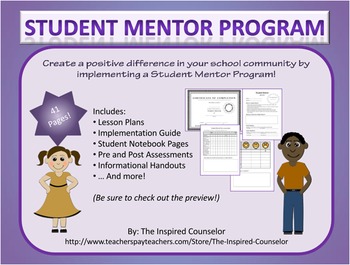
Student Mentor Program

Finally, if you have started a Student Mentoring Program at your school, I'd love to hear how it is going and any suggestions that you have for the program!

Saturday, February 16, 2013

Simon's Hook: A Story About Teases and Put-Downs Lesson Plan Ideas

With the third graders, I did a unit on Simon's Hook. There is so much that can be done with the book! Simon's hook is a story about how to deal with teasing and put-downs. When Simon has a bad hair day and someone calls him a name, he gets very upset. Grandma Rose then tells Simon a story about how to handle teases and put-downs, from a fish's perspective. When someone teases you, they are throwing you the hook. When you get upset, you are biting onto their hook. Grandma Rose helps Simon learn how to "swim free" from the teasing hooks that people toss his way.


Youtube Videos

Grandma Rose's Neighborhood Youtube Videos: As a review of the book, or even in place of the book, show these videos to the class. Part one has the intro about how teasing is "throwing a hook". Part two is the story about how the fish learned to swim around the hooks instead of biting. Part three shows some role plays about handling teasing.
Thumbnail
Grandma Rose's Neighborhood Part 1
Thumbnail
Grandma Rose's Neighborhood Part 2

Thumbnail
Grandma Rose's Neighborhood Part 3

Which Strategy is it?

After discussing the strategies of how to avoid biting the hook, we played a little class game. I wrote each of the five strategies on the board. After another student reads the scenario, the class would show me with their hands which number they think the scenario is an example of. Below are the scenarios that I used.

Ignore
The whole class is about to play kickball. Sam says to the Dustin, “We’re gonna beat you guys!”. Dustin looks at Sam and shrugs, thinking to himself, “I really don’t care if they win”

Amy and Sara are playing checkers when Matt approaches them and says to Sara “Your mom is fat”. Amy and Sara continue to play checkers as if nothing had happened.

Agree
Patrick is telling a joke to his friends. “Knock knock!” (who’s there?) “Interrupting Cow!” (interrupting Co-) “MOO!!!”. Chris looks at Patrick without laughing and says- that was a dumb joke. Patrick says “yeah, it sure was!”

Distract
While playing dodgeball, George says “Ha ha you missed me!”. John responds by saying “what I really miss is my X-box. Man I would love to be at home playing that now!”

Laugh/joke
Josh just got finished telling a story to his friends about embarrassing himself this weekend with his family. When he was finished,  Jason said, “wow. Really? How dumb can you honestly be to think that would work!” Josh responds by saying “well, you’d be surprised just how dumb I can be sometimes”

Stay away (avoid)
Kelly started calling Sharon names on the playground. Sharon decided that she’s had enough of the name calling, so she decided to turn around and walk in the other direction from Kelly. 

Role Plays

Students were divided into groups of 4 and were assigned one of the 5 strategies. They came up with a short role play of a situation where a kid used that strategy. While presenting to the class, the other groups had to figure out which topic each of the groups had chosen. 

Game Time!

This is an activity that I saw on lifelessonsforlittleones.com. There is a ship at the top of the board that has a teasing remark, "You're a little shrimp!". There are a lot of fish cards in a pile that have responses to that statement. If the statement is one that "bites" the hook, it is place on top of the baited hook/strings. If it is a statement that helps the fish avoid the hook, they are place on the side with "Free Fish".

Take Away!


At the end of the unit, each of the students received one of these cards to remind them of what they can do to avoid "biting the hook".

Other Activities: 

  • http://www.freekidscrafts.com/handprint_fishing_pole-e1236.html Give each kid a hand cutout, fishing pole, string, and two paper fish. Have kids write a teasing comment on the pole or hand cutout. On one of the fish, write a comment that would be considered "biting" the hook. Glue this fish to the string. On the other fish, write a comment that would represent the "free" fish. 


Monday, January 21, 2013

Mr.Potato Head- classroom management

Introducing: Mr.Potato Head! I have used this as a visual for whole body listening. At start of a classroom guidance or small group lesson, discuss what ears, eyes, mouth, hands, brain (hat), and bottom should be doing, adding body parts as you discuss. If you notice that kids are not using their body appropriately during the group or class, remove that part of Mr.Potato head. Replace when you have everyone's attention again. 

At the end of class, if Mr.Potato Head has all of his parts, give the class a compliment when their teacher arrives to pick them up, or another agreed upon incentive. For smaller groups, you could pass around Mr.Potato Head at the end. 

(I believe the original Mr.Potato Head classroom management strategy came from here, but please correct me if I'm wrong!)
How would you use Mr.Potato Head?


(Inspiration for Mr.Potato Head from here)

Sunday, January 20, 2013

Confessions of a Former Bully Lessons


I just got the book, "Confessions of a Former Bully" by Trudy Ludwig, and I have already used it several times!

Here's the book description:
"After Katie gets caught teasing a schoolmate, she's told to meet with Mrs. Petrowski, the school counselor, so she can make right her wrong and learn to be a better friend. Bothered at first, it doesn't take long before Katie realizes that bullying has hurt not only the people around her, but her, too. Told from the unusual point of view of the bullier rather than the bullied, Confessions of a Former Bully provides kids with real life tools they can use to identify and stop relational aggression."

So far, the 3rd and 4th grade girls that I have used this with really seemed to grasp the concepts. This opened the door to talk about the motives behind one girl's bullying behaviors, helped another girl understand ways that she could help when she is a bystander, helped a girl begin to see what the good and bad qualities of a friend are, and gave some useful strategies for another girl who is often the target of teasing. While this book could easily be read from cover to cover, I have been using it more as a reference book depending on the specific situation. I could see this book being the topic of a girls small group, discussing a few pages at a time.

Once concept in the book talks about using "empower" tools as a way of dealing with bullying/teasing. I created these cards as a takeaway for kids, using the same wording from the book and clipart of the tools that correspond with the book.


Empathy and Perspectives Lesson

I did a lesson with 4th graders on empathy and seeing a situation from another person's perspective. We discussed how two people in the same situation can see things completely different. 

To emphasize this point, I had two volunteers stand up and face each other, a few feet apart. I put a picture of a "6" in between them, and asked them to name the picture. One said it was a 6, the other said it was a 9. Then I asked the class: Who is right? How can both be right? 

The same thing applies in conflicts. Even if you know for sure that you are right, take a moment to consider why the other person also thinks that they are right. Is there another perspective?


Other ways to use concept is to use optical illusions such as this one:


Progress Cards

I recently bought the Progress Cards book- this is honestly one of my best school counseling purchases yet! It is a great motivational tool to increase positive behaviors! I am using the blank cards to let the students come up with their own goals, using cards as reference.

I have been using the blank practice cards with a few students so that they can work towards their very specific goals that they set for themselves. For younger kids, I have created a smaller practice card that only has two or three blanks for goals.

Once we have decided on what goals to set, we then use the counselor and teacher rewards to see what the student is willing to work for. For example- 10 minutes of your teacher's undivided attention, helping your favorite teacher for 20 minutes, having lunch with a friend, getting 15 minutes on the computer, and a positive phone call home. The student sorts out the reward cards into three groups: Absolutely Love (big rewards), Like (small rewards), and Don't like (put aside). The small rewards will be a daily reward for achieving the day's goals. The big rewards will be a weekly reward for achieving the daily goals for all 5 days. I have been very surprised at the things that the kids have picked that they really want to work for!


Bullying Wordles


After four weeks of lessons about bullying, we headed to the computer lab to create some "Wordles" to sum everything up. 

We began by briefly going over some of the important terms that we have learned and other things that we have talked about during lessons. For example, we talked about what bullying is: MOO- Mean, On purpose, and Ongoing. We talked about how to handle bullying: HA HA SO- Help, Assert yourself, Humor, Avoid, Self-talk, Own it. We talked about the role of the bystander using the book "say something".  Students were encouraged to come up with 20 unique words from the things that we had talked about over the last several weeks. 

Below is the bulletin board they were displayed on! 

Make your own Wordle here: www.wordle.com


Tattle Tongue Mask Lesson

We read A Bad Case of Tattle Tongue by Julia Cook in first and second grade, and did a mini-unit based on the book. Here is the book description from Amazon:
Josh the Tattler doesn't have any friends. He tattles on his classmates, on his brother, and even on his dog! He tattles so much that he wakes up one night to find that his tongue is yellow, unusually long, and covered in bright purple spots! Will a bad case of Tattle Tongue teach him a lesson? A Bad Case of Tattle Tongue gives teachers and counselors a humorous, cleverly creative way to address the time-consuming tattling-related issues that often sap classroom energy and thwart teaching opportunities. Parents who "battle the tattle" at home, on the playground, in the grocery store, or anywhere else, can use this book to both entertain and enlighten their children about "The Tattle Rules." Every adult that desires to help children understand the differences between unnecessary tattling and the necessity of warning others about important matters needs this book!
Week 1: 
On the first day, we read the book and discussed the difference between tattling and telling. This was taught using "little problems" and "big problems". Big problems are problems where someone or something is being hurt or could get hurt. Everything else is a little problem that can usually be handled without an adult. Using slips of paper with problems on it, students had to decide if the problems were little problems or big problems.
Week 2: 
During the second week, we started with a review of the book, and reviewed what little problems and big problems were. Today, we talked about why people tattle, and what people could do besides tattling. We talked about how to handle "little problems" and discussed a few scenarios where students had to decide what they would do in that situation.
Week 3: 
On the final day discussing this book, we made these adorable masks! I first gave each student a paper plate. On the back side, they completed the sentence: "I will not tattle because..." Once they had compelted their sentence, I gave them a cut out picture similar to Josh in the story. Students colored their picture any way they wanted to. At the end of class, I let students who wanted to share tell the class their sentence and show their mask.