Search This Blog

Showing posts with label video. Show all posts

Sunday, March 3, 2013

GCS Counselors Meeting notes

I found the GCS Counselor's meeting to be very interesting and thought provoking! Here are some of the main points:


  • Emotional Connections through video: The number one thing that motivates a person is having an emotional connection. By watching a video as an introduction, the students are emotionally activated and can easily relate to the video without talking about themselves. Video is the best emotional media that can be used in school. Here are some links to a few of my favorite video resources:
    • http://gcsnc.connectwithkids.com/
    • http://pbskids.org/itsmylife/video/index.html
    • http://www.mariadismondy.com/2012/10/youtube-teaches-character/
    • http://pinterest.com/jkl5502/videos-character-education/
  • Similarities, not differences: Another thought-provoking concept mentioned at this meeting is that we should not show kids how they are different from one another, we need to show them how they are the same. It is natural for kids to pick up on the differences, but when they are unable to see how they are similar to others is when kids develop empathy for others. In a world where it is becoming "cool to be cruel", having a firm foundation on empathy can be a deciding factor between kids bullying others or being kind. 

  • Extrinsic Motivation: The speaker also talked about how children today are primarily extrinsically motivated and that paradigm shift is leading to a huge increase in mental health issues in early adulthood (top 3: anxiety, depression, and narcissism). To illustrate the problem with being only extrinsically motivated, the speaker used a metaphor of leading a chicken with breadcrumbs to a certain destination. When the chicken reaches that destination, the bread crumbs stop and the chicken is left not knowing what to do or where they are at. The chicken is the child, the bread crumbs are the adults giving extrinsic rewards for doing the small things. Once the kids reach the destination (college), the breadcrumbs stop coming and they do not know what to do. This causes a lot of anxiety and depression. 


  • "Comparison is the thief of joy"- Theodore Roosevelt- One study compared the happiness of two families- one with an income of 200k, the other with 60k. The study found that in general, there was not a difference in the happiness, UNLESS they were living next to each other. Your belongings and possessions alone do not determine how happy you are, but when you start comparing what you have to what someone else has, you become unhappy. 

Saturday, February 16, 2013

Simon's Hook: A Story About Teases and Put-Downs Lesson Plan Ideas

With the third graders, I did a unit on Simon's Hook. There is so much that can be done with the book! Simon's hook is a story about how to deal with teasing and put-downs. When Simon has a bad hair day and someone calls him a name, he gets very upset. Grandma Rose then tells Simon a story about how to handle teases and put-downs, from a fish's perspective. When someone teases you, they are throwing you the hook. When you get upset, you are biting onto their hook. Grandma Rose helps Simon learn how to "swim free" from the teasing hooks that people toss his way.


Youtube Videos

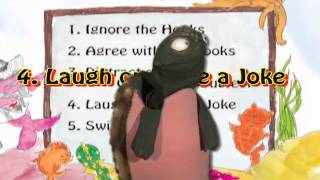
Grandma Rose's Neighborhood Youtube Videos: As a review of the book, or even in place of the book, show these videos to the class. Part one has the intro about how teasing is "throwing a hook". Part two is the story about how the fish learned to swim around the hooks instead of biting. Part three shows some role plays about handling teasing.
Thumbnail
Grandma Rose's Neighborhood Part 1
Thumbnail
Grandma Rose's Neighborhood Part 2

Thumbnail
Grandma Rose's Neighborhood Part 3

Which Strategy is it?

After discussing the strategies of how to avoid biting the hook, we played a little class game. I wrote each of the five strategies on the board. After another student reads the scenario, the class would show me with their hands which number they think the scenario is an example of. Below are the scenarios that I used.

Ignore
The whole class is about to play kickball. Sam says to the Dustin, “We’re gonna beat you guys!”. Dustin looks at Sam and shrugs, thinking to himself, “I really don’t care if they win”

Amy and Sara are playing checkers when Matt approaches them and says to Sara “Your mom is fat”. Amy and Sara continue to play checkers as if nothing had happened.

Agree
Patrick is telling a joke to his friends. “Knock knock!” (who’s there?) “Interrupting Cow!” (interrupting Co-) “MOO!!!”. Chris looks at Patrick without laughing and says- that was a dumb joke. Patrick says “yeah, it sure was!”

Distract
While playing dodgeball, George says “Ha ha you missed me!”. John responds by saying “what I really miss is my X-box. Man I would love to be at home playing that now!”

Laugh/joke
Josh just got finished telling a story to his friends about embarrassing himself this weekend with his family. When he was finished,  Jason said, “wow. Really? How dumb can you honestly be to think that would work!” Josh responds by saying “well, you’d be surprised just how dumb I can be sometimes”

Stay away (avoid)
Kelly started calling Sharon names on the playground. Sharon decided that she’s had enough of the name calling, so she decided to turn around and walk in the other direction from Kelly. 

Role Plays

Students were divided into groups of 4 and were assigned one of the 5 strategies. They came up with a short role play of a situation where a kid used that strategy. While presenting to the class, the other groups had to figure out which topic each of the groups had chosen. 

Game Time!

This is an activity that I saw on lifelessonsforlittleones.com. There is a ship at the top of the board that has a teasing remark, "You're a little shrimp!". There are a lot of fish cards in a pile that have responses to that statement. If the statement is one that "bites" the hook, it is place on top of the baited hook/strings. If it is a statement that helps the fish avoid the hook, they are place on the side with "Free Fish".

Take Away!


At the end of the unit, each of the students received one of these cards to remind them of what they can do to avoid "biting the hook".

Other Activities: 

  • http://www.freekidscrafts.com/handprint_fishing_pole-e1236.html Give each kid a hand cutout, fishing pole, string, and two paper fish. Have kids write a teasing comment on the pole or hand cutout. On one of the fish, write a comment that would be considered "biting" the hook. Glue this fish to the string. On the other fish, write a comment that would represent the "free" fish. 


Sunday, January 20, 2013

Secret Service Group


I'm very fortunate to have a site supervisor for my internship who encourages me to try new things and to make mistakes. I've done a little of both with this group! When I told her about the idea of having a Secret Service group, she was very supportive of the idea. I got the inspiration for the Secret Service group from Dianne Senn’s book, Small Group Counseling, Grades 2-5. After reading about her Secret Service club, my wheels started to turn!

Before the group started, I met with each student. I gave them a manila envelope with “TOPSECRET” printed on it. Inside the envelope, was the official secret service invitation and parent consent to be in the group. I told each student to return the envelope with parent signatures to asecret location outside of my office. I also explained to them that the US Secret Service’s job is to serve and help the country through protecting its’ leaders. This group will serve and help the school by doing random acts of kindness (Intro by Dianne Senn).

Another great introduction to Random Acts of Kindness is a Youtube video by Life Vest Inside- Kindness Boomerang. In this video, one act of kindness causes another person to want to do something kind for another, and so on. This is a great "real life" example of paying it forward, and sparks a conversation about how easy it can be to be kind. Click on the picture to play the video.

Each week, I assign a secret mission to the Secret Service Agents. This could be anything from giving compliments to a classmate, or writing anonymous thank you notes to teachers around the school. I usually print the assignments out on a half-sheet of paper so that it fits into their envelop. Some of the missions may be written in code so that the students have to decipher it first! The students keep track of their service assignments in a journal. After each completed assignment, the students record the responses of the recipient of the deed, or their own responses (feelings, thoughts, other ideas). We use the journal as a springboard for group discussions.

I have also challenged my group of 6 students to do a combined total of 100 Random Acts of Kindness throughout the duration of our group meetings. We brainstormed different things that each person could do to earn extra stars (see list below). My goal in doing this is to encourage them to constantly be on the lookout for kind things to do for other people, rather than simply focusing on one task each week. A quote/motto that we often refer to in group is, "No act of kindness, no matter how small, will go unnoticed" -Aesop. They are not doing the services to get recognition for themselves, but rather for the satisfaction of knowing that they are making a difference in someone's life.

I created a group notebook (below) that is hidden in an “undisclosed location”. This notebook serves as a source of information and a means of communication for group members. If the students have questions during the week, they can refer to the notebook. (This also helps me with the group since I am an intern and am not at school all week to answer their questions). Included in the notebook are some of the most common questions- the date and time of the next meeting, the agenda for the next meeting, our list of ideas for secret service projects, extra copies of handouts, and a chart to keep track of the 100 assignments as they are completed. 

This group has been great for building students' friendship, leadership, and social skills, in addition to promoting students' positive self-esteem. So far, the kids are very enthusiastic about being members of the Secret Service at school. I have already noticed some changes in how the students are treating one another during group time. They were beyond excited to learn that they are the school's ONLY Secret Service, and that the only adults who know about the Secret Service besides me are their classroom teachers and their parents. I am excited to see how the rest of our group meetings turn out!


Extra Stars Ideas:
Pick up trash in your classroom
Be a peer helper to a life skills class 
Read to younger students 
Offer to help someone in your class with an assignment they are struggling with
Say thank you to cafeteria staff 
Smile to someone who may be having a hard day
Say “good morning” to someone you don’t normally speak to
Offer to get extra materials for someone (pencil, paper, textbook, fork, napkins, etc)
Stand up to a bully- don’t just be a bystander
Do an extra chore at home without being asked
Invite someone to play with you at recess who is not playing with anyone
Send a letter to an adult friend (with parent’s help)
Write a thank you note to a parent
Host a collection drive for an important cause
Put up positive posters around school (get adult approval first)
Give compliments to classmates, teachers, or students you do not know
Leave anonymous positive notes in a classmate’s or teacher’s desk
Put out birdseed after it snows
Hold the door open for the next person
Draw a picture for someone
Sit by someone different at lunch
Take time to get to know someone new
Puppet show to teach younger kids about friendship
Offer to help a specials teacher during your lunch time