Search This Blog

Showing posts with label small group. Show all posts

Tuesday, June 24, 2014

Student Mentor Program

I have recently designed a new program that I am excited about implementing! It's a Student Mentor Program, in which carefully selected older and more responsible students are trained to mentor younger students who may be struggling with social, academic, or behavioral concerns. Similar to "Peer Mediators" or "Peer Helpers", the Student Mentors will help the counselor reach even more students and create a lasting impact on  the school environment.

Who??
The program would work great with elementary or middle school, but could also easily be adapted to high school. Alternatively, if you have different level schools nearby, arrange it to have high school students mentor middle school students.

Mentors would be responsible role model students who apply (and interview!) for the position of mentor. They would meet regularly with the School Counselor for quick individual check-ins and for after school group trainings. They will be taught how to help younger students manage conflicts, handle strong emotions, and provide general encouragement and friendship.

Mentees would be students who are "frequent flyers" in the counselor's and/or pricipal's office. The may need additional support outside of what the caring adults in the school can provide. An example of the ideal mentee is one who is constantly asking to speak to the school counselor about little problems, or one who is trying to fit in with their peers. To these students, their mentor will be an older friend who they get to hang out with and talk to once a week.

What?
Student mentors will be trained in being a mentor. They will receive explicit instruction on how to encourage and lead a younger student, and how to help with many problems that they face. In a way, mentors will be "Counselor Helpers" or "Peer Helpers". When the counselor's schedule is packed (like it always is), student mentors can help younger students with some of the small problems that they face, while becoming expert problem solvers themselves!

When and where?
I see this being a year-long program. Mentors should meet with their mentee once per week for 20-30 minutes, during non-instructional time. Training would take place at least once per month after school, when all mentors are able to attend. Mentors would also check in periodically with the counselor (5-10 minutes, before or after school) so that the counselor can monitor their progress and answer any questions they have.

Why?
Let's face it- School Counselors are BUSY!! This mentor program is a way that you as a school counselor can impact even more students. You teach mentors how to help, and start the snowball effect of students helping students. Soon enough, your entire school will feel the impact! There have been many studies done about the effects of mentoring on student achievement, but unfortunately there is a lack of willing {adult} mentors in our community. But who says mentors can't be children too?

 
(Get this poster FREE here)

Suggested steps to implement program:
  1. .    Inform teachers of the mentoring program at a staff meeting. Explain the potential benefits for mentors and for mentees, and how it will impact the school as a whole.
  2. .    Class introduction lesson. Meet with classes of older students to discuss the mentoring program. Emphasize the amount of responsibility and dedication that being a mentor will require. Leave information and copies of the Mentor Application with teacher. Teacher will give applications to students who are interested, as well as the parent information sheet. (Another possible route is to open the applications up to your student council or other student leadership groups, or simply ask teacher for recommendations and ask those specific students if they are interested)
  3. .    Once students turn in complete applications, meet with those students individually or in a small group (lunch bunch). Discuss overall objective of the program, specific requirements, and answer any questions they may have.
  4. .    Meet with possible mentees, explaining what their mentor will be doing with them. Give mentees pre-assessment. Mentees should be students in younger grades who need additional support, but do not typically have big problems or concerns. Check with parents of mentees before initiating mentoring.
  5. .    Schedule after-school training session to go over additional details of the program. (See list below of suggested training items) Give out pre-assessments to all mentors.
  6. .    Pair up mentors with mentees.
  7. .    Meet regularly with mentors to discuss progress (before school check-ins or during lunch) 

Suggested Trainings: At each training, include a handout for students to keep in their notebook for reference. I would suggest doing an interactive notes style handout to further engage the students.
  •       What specifically is expected of mentors (What is a mentor? How can I help?)
  •       How to conduct a peer mediation session
  •       Promoting empathy and kindness in others
  •       Strategies for handling anger, sadness, stress
  •       Strategies for solving "small problems"
  •       What is effective communication?
  •       What to do if… (reporting "big" problems, what if you're not sure what to say?, etc)

Other fun mentor program ideas
  •       Have a "Mentor Night" or "Mentor Fair" at the end of the school year where student mentors present information on their impact with younger students. Have students create trifold poster with what they have learned from the program, how they helped their mentees, and the overall impact of the mentoring program on the school. For maximum participation, hold the event during a PTA night or in conjunction with other big school events (talent show, science fair, etc)
  •       Create matching T-shirts or bags for mentees (Vistaprint!)
  •       Give out certificates for participation in the Mentor program at Honor Roll ceremony.


If you are interested in starting a Student Mentoring Program at your school, check out my Student Mentor Program Pack on Teachers Pay Teachers! It includes information sheets, application, Mentor Notebook pages, assessments, and four training lessons. 
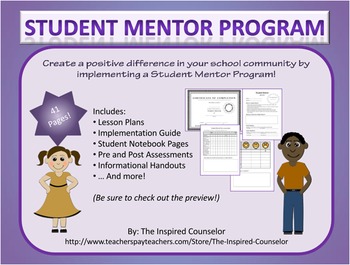
Student Mentor Program

Finally, if you have started a Student Mentoring Program at your school, I'd love to hear how it is going and any suggestions that you have for the program!

Thursday, August 22, 2013

Origami Group

After learning about how to make Never Ending Cards, I started thinking about what kids could learn from folding paper. Turns out there is quite a bit that can be learned by making a few folds in a sheet of paper! Below are just a few of the benefits that students would gain from learning Origami.

Academic
  • Shapes (Identifying basic shapes, new shapes made from folding)
  • Symmetry (Much of Origami is symmetric)
  • Angles (You had a right angle, but folded it in half. Now how many degrees is the angle?)
  • Fractions (You just folded this paper in half three times. How many sections do you have?)
  • Following Directions (Some instructions for making Origami can be very specific and detailed.) 
  • Reading with a purpose (For an added challenge, only provide step-by-step instructions and no pictures)
Personal/Social
  • Teaches patience and concentration through attention to detail
  • Teaches perseverence- if they get frustrated with a project, keep trying
  • Making mistakes is a part of the learning process
  • Problem Solving skills- How can you fix your mistakes/ "happy accidents"
  • Gives students a positive hobby/ skill that can be shared with others
  • Gives an outlet for ADHD energy and fiddling
  • Kids can share their hobby through making gifts for others (encourage Random Acts of Kindness!!)
Career
  • Learning how to create a 3D object out of a flat sheet of paper = foundation of Science, Technology, Engineering and Math (STEM)
  • Students learn to pick up on and apply patterns from folding to other subjects and careers 
Origami Group
I have not yet run an origami group, but it's definitely on my list of groups I'd like to run! I would gear it to 3rd grade and up. Each week, we would focus on a different topic such as having patience, making mistakes, following directions, etc. I would also have them create at least one project each week. I might even throw a challenge at them to deconstruct and recreate a completed origami project. They could make origami to sell as a school fundraiser, or lead a school wide service project making origami for Sandy Hook.

Classroom Guidance Lesson

Using the book, Spread Your Wings and Fly by Mary Saunders, have students fold along with the story in the book as you read. Here is the book description from Amazon.com: An Origami Fold and Tell...the ancient Japanese art of origami provides a framework for enhancing self-esteem and achieving spiritual attunement that will stay with readers as they work through the book, as well as the various phases of their lives.

Sadako and the Thousand Paper Cranes: Here is the book description from amazon: Born in Hiroshima in 1943, Sadako was the star of her school's running team, until the dizzy spells started and she was forced to face the hardest race of her life-the race against time.

Empowering Kids 
I would like to leave you with one final note- a direct quote from an article on Enso Journey: The Power of Origami: How it can make you a better person: (I definitely encourage you to read this article!)

"I created something out of nothing. From a simple piece of paper, a new creature was born. For each new piece I made, I felt I had the power to change the world. I could do anything, even if I had nothing to begin with, I could do it."

Saturday, April 27, 2013

End of the Year Closure Lessons

This week was very bitter sweet for me, though more sweet than bitter! I have now finished my school counseling internship and will be graduating in just two weeks! This week consisted of tying up some loose ends with individual students and saying my good-byes to groups and classes. Below are some of the closing/termination activities that I did with my students, and some that I didn't do but wanted to share anyways. I hope you enjoy!

Individual

  • Paper Finger Puppets- Found on the blog Seven Thirty Three, I taught some of my younger students how to make these very simple puppets. A lot of my individual work with the younger students has involved puppets. As a final individual session, we both made a paper finger puppet and used it to say goodbye. The students absolutely LOVED it! And it gave them something to take with them to remind them of our time together. 
  • Writing notes- Before I left for the year, I wrote several of the students personalized notes emphasizing their growth over the school year, and included some empowering words to encourage them to continue to work towards their goals. 
  • Bridge- Have the student draw a bridge in the middle of a sheet of paper. One one side is where the student used to be, and on the other is where he is now. Under the bridge- what obstacles did you have to overcome? This can also be done with two bridges, with the last one being where you would like to be, and what obstacles you might have to overcome to get there. This activity can be used at the beginning of counseling as well to give direction to the sessions. 
  • Letters to the past/future you-Have the student write a letter to him/herself in the past or the future. If you could time travel to the past/future what would you tell yourself?
  • Lines of Feelings. Ask the student to draw a line that represents their feelings over the past (year, month, week, etc). All of the lines will vary, but usually the jagged or rough lines in red or orange are used to signify anger or discontent, and the smooth, flowing lines in blues and greens are usually used to show calmness and contentment. After the lines are drawn, the student can expand on them by writing about what the lines represent, how it feels to draw them, or to whom or what they are directed.  

Groups
  • Flower Petals- The flower represents the group growing over time. A flower starts as a bud, and you can not see the petals yet. But over time, with water and sun, the petals begin to unfold, creating a beautiful flower. Place a circle in the center of the group, and tell them that this represents the bud, before group began. There were many things that you know now that you didnt know before. Give each student a paper flower petal, and say one thing that they have learned from the group. Have the student symbolically tape the flower petal to the circle. Continue until everyone has done this. 
  • String tying- From Diane Senn's book Creative Approaches to Counseling Individual Children. I used this at the end of my fourth grade girls friendship group to help remind the girls that it is okay to ask for help when they have problems, and that your friends are often a great source of help. Start by giving each girl a string that is at least one foot long. Tell them to tie a knot in a string. This is pretty simple for them to do. Some problems are easy to handle yourself. Then, instruct them to hold both ends of the string without letting go and tie a knot. Tell them that it is okay to ask for help. After letting them try for a few minutes, ask them if they would like some help. Ask one student to cross her arms, then hand her the ends of the string in each of her hands. Have her unfold her arms without letting go of the string, and a knot will be tied in the string. Allow the girls to help one another with this. Tell the girls that sometimes we have problems that we are not sure how to fix, and it is okay to ask someone else for help, and sometimes it takes a creative solution to solve their problems. Friends help us get through some of the tough problems we have, but when friends cant help, your school counselor is still there for you. 
  • Choose a Picture- Print out a variety of different pictures, such as animals, scenery, symbolic pictures, people, etc that represent a variety of emotions and different points of view- both positive and negative. Lay the pictures out on the floor and ask students to choose the picture that shows how they feel, what they will take away from the experience/group. Process what the picture chosen means to each individual. This site does a great job of explaining this method of closure. 
  • Group Puzzle/Mandala- Give each student a piece of the puzzle or a piece of the mandala and let each student decorate it. At the end, let each student symbolically place their puzzle piece or mandala piece back into the puzzle, saying one thing that they have enjoyed or have learned during the group. Allow students to keep the finished product in their class to remember the good times together.
Classroom
  • The Giving Tree- I wanted to incorporate a finger-print tree into the lesson somehow, and my supervisor suggested I use the The Giving Tree with it. That got my wheels turning! I used the book with first grade and up, adjusting the lesson slightly to accommodate for developmental differences. Before reading the book, I asked the students to be thinking about who they can relate to more- the tree or the boy. I then read the book to the class without stopping for inserting my own interpretation of what was going on. After I read the book, I asked them again who thinks they are more like the tree or more like the boy. In most classes it was about half and half. I let a few students explain why they thought they were more like one or the other. Then I told them that sometimes I feel like both. I feel like the tree because as a counselor, I will gladly give my students anything and everything that I have to help them when they need it. But at times, I have felt like the boy, and the students were the tree. In the same way that the boy got what he needed every time he asked for it, I got what I needed to become a school counselor from the students. I told them that they have taught me so much more than I have taught them this year, and thanked them for helping me learn how to be a school counselor. At the end of the lesson, I let each student come up and put a finger print on the tree, using a washable marker. (In later classes I decided to just have them write their names on the branches in different colors). I then wrote a note to the class and gave it back to them to keep in their classroom to remember our time together, and to remember that it's okay to be like the tree AND like the boy. 
  • Toss 'n Talk ball- For some classes, the students had many questions for me about why I am leaving and what I would be doing after I'm gone. After answering a few questions, I got out a inflatable ball and asked students what their favorite memory with me was this year, in 2-3 words. I used the ball as a talking tool- only the person who has the ball can talk. I gave each student a turn to catch the ball and say a favorite memory. 
  • Class Rap- I did not do this one, but it was my back up. The students are finishing up a poetry unit, so to incorporate this, I was going to have the students write a haiku about what they will take away from our time together this year. After they wrote the poems, we would all sit in a circle. Depending on the age and ability, I would divide the class into 2-4 groups, and give each group a rhythm to clap to a given beat, and maybe even having a student being our "beatboxer" to be our percussion. Then one at a time, students would read their poems in rhythm with the class's beat. 
  • Empowering Words- Adapted from Kellybear.com-  Close the year out with some positive and encouraging words! Have students think about some thoughts that help them feel better when they are feeling sad.This is called positive self-talk. Brainstorm thoughts that can help on the board. After the class is brainstormed out, have them choose one statement that is meaningful to them and draw a picture about it. Allow time to share. Remind kids that even though they may feel sad about things (such as a teacher/counselor intern leaving them, or something else sad), they have the power to control their thoughts and can think about these things to make them feel better. Leave with encouraging words challenging them to be their best! (These positive self-statements could make a nice end-of-year bulletin board!)
  • Paper Quilt- have each student draw their favorite memory from the year on a square sheet of paper. Tape the pictures together, or put into a gallon-bag quilt format to display, like the one here


Sunday, January 20, 2013

Secret Service Group


I'm very fortunate to have a site supervisor for my internship who encourages me to try new things and to make mistakes. I've done a little of both with this group! When I told her about the idea of having a Secret Service group, she was very supportive of the idea. I got the inspiration for the Secret Service group from Dianne Senn’s book, Small Group Counseling, Grades 2-5. After reading about her Secret Service club, my wheels started to turn!

Before the group started, I met with each student. I gave them a manila envelope with “TOPSECRET” printed on it. Inside the envelope, was the official secret service invitation and parent consent to be in the group. I told each student to return the envelope with parent signatures to asecret location outside of my office. I also explained to them that the US Secret Service’s job is to serve and help the country through protecting its’ leaders. This group will serve and help the school by doing random acts of kindness (Intro by Dianne Senn).

Another great introduction to Random Acts of Kindness is a Youtube video by Life Vest Inside- Kindness Boomerang. In this video, one act of kindness causes another person to want to do something kind for another, and so on. This is a great "real life" example of paying it forward, and sparks a conversation about how easy it can be to be kind. Click on the picture to play the video.

Each week, I assign a secret mission to the Secret Service Agents. This could be anything from giving compliments to a classmate, or writing anonymous thank you notes to teachers around the school. I usually print the assignments out on a half-sheet of paper so that it fits into their envelop. Some of the missions may be written in code so that the students have to decipher it first! The students keep track of their service assignments in a journal. After each completed assignment, the students record the responses of the recipient of the deed, or their own responses (feelings, thoughts, other ideas). We use the journal as a springboard for group discussions.

I have also challenged my group of 6 students to do a combined total of 100 Random Acts of Kindness throughout the duration of our group meetings. We brainstormed different things that each person could do to earn extra stars (see list below). My goal in doing this is to encourage them to constantly be on the lookout for kind things to do for other people, rather than simply focusing on one task each week. A quote/motto that we often refer to in group is, "No act of kindness, no matter how small, will go unnoticed" -Aesop. They are not doing the services to get recognition for themselves, but rather for the satisfaction of knowing that they are making a difference in someone's life.

I created a group notebook (below) that is hidden in an “undisclosed location”. This notebook serves as a source of information and a means of communication for group members. If the students have questions during the week, they can refer to the notebook. (This also helps me with the group since I am an intern and am not at school all week to answer their questions). Included in the notebook are some of the most common questions- the date and time of the next meeting, the agenda for the next meeting, our list of ideas for secret service projects, extra copies of handouts, and a chart to keep track of the 100 assignments as they are completed. 

This group has been great for building students' friendship, leadership, and social skills, in addition to promoting students' positive self-esteem. So far, the kids are very enthusiastic about being members of the Secret Service at school. I have already noticed some changes in how the students are treating one another during group time. They were beyond excited to learn that they are the school's ONLY Secret Service, and that the only adults who know about the Secret Service besides me are their classroom teachers and their parents. I am excited to see how the rest of our group meetings turn out!


Extra Stars Ideas:
Pick up trash in your classroom
Be a peer helper to a life skills class 
Read to younger students 
Offer to help someone in your class with an assignment they are struggling with
Say thank you to cafeteria staff 
Smile to someone who may be having a hard day
Say “good morning” to someone you don’t normally speak to
Offer to get extra materials for someone (pencil, paper, textbook, fork, napkins, etc)
Stand up to a bully- don’t just be a bystander
Do an extra chore at home without being asked
Invite someone to play with you at recess who is not playing with anyone
Send a letter to an adult friend (with parent’s help)
Write a thank you note to a parent
Host a collection drive for an important cause
Put up positive posters around school (get adult approval first)
Give compliments to classmates, teachers, or students you do not know
Leave anonymous positive notes in a classmate’s or teacher’s desk
Put out birdseed after it snows
Hold the door open for the next person
Draw a picture for someone
Sit by someone different at lunch
Take time to get to know someone new
Puppet show to teach younger kids about friendship
Offer to help a specials teacher during your lunch time